

With Pixelhobby you put together a picture from lots of tiny pixels. No glue, no iron, no drying time. You take a pixel, press it onto a pin, and it stays put.
The quickest way to see what that looks like is the video.
What you need
Four things, nothing more: a base plate, pixel squares in your colors, a template and, ideally, tweezers.
The base plate is see-through and covered in tiny pins. The normal one has 40 by 50 pins, which makes 2000. The small one has 24 by 24, so 576.
The pixels don't come loose; they hang on a pixel square. It is about 6 by 6 centimeters, and the pixels hang in it on a grid. You remove them one at a time.
With Classic (Mini), a pixel is 2.5 by 2.5 millimeters and each pixel sits on exactly one pin. With XL (Midi) it is 5 by 5 millimeters, and one pixel fits onto exactly four pins.
The tweezers are not a must. Many people pixel with their fingers, especially with XL (Midi). With Classic (Mini), though, it is much easier with tweezers. They won't make you faster; there are simply that many pixels.
How it works
You put the template under the see-through base plate. Looking through the plate, you can see which square gets which color.
If you print the template yourself, pay attention to one thing, or all your work will be wasted: it has to be printed at actual size. In Acrobat the setting is called exactly that. If you fit it to the page size when printing, the squares no longer line up with the pins and the template is useless.
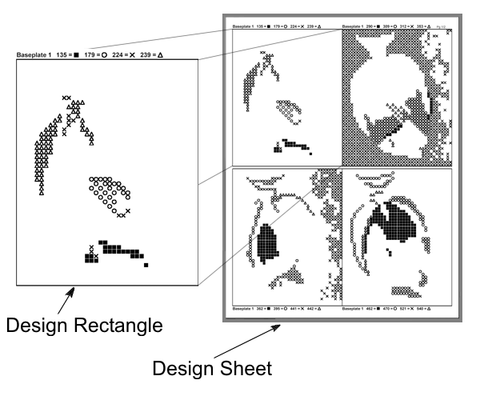
The template is divided into rectangles, assuming we are working with the normal base plate. Each template rectangle shows four symbols, and each symbol stands for one color. So four colors per rectangle.
For a whole base plate you need more than four colors, so several template rectangles go under the same plate one after the other. You place all four colors of the first rectangle, lift the plate and lay it on the next one.
Before each switch, check that all the symbols really are filled. A gap you forgot is a pain to find later.
And now the step where most pictures go wrong: on the back of the base plate there is a transparent arrow. It has to point in the same direction every time you switch, otherwise part of your design will end up rotated. Our recommendation: always let the arrow point at something, ideally toward the color numbers. Then, even after a longer break, you'll still know which way round the plate goes on the picture.
Within a rectangle, it's best to place one color after another. That way you can be sure you've caught all the symbols for a color.
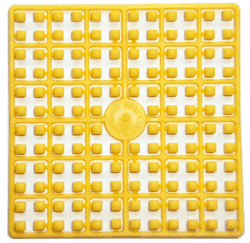

The color number is on the back of the pixel square, on the round bar in the middle. That way you can find the same color again later if you want to reorder. The color numbers are the same for both pixel sizes: 100 is the same white in Classic (Mini) as in XL (Midi), and 441 the same black.
Don't be surprised: you need a different number of pixels of each color, and therefore a different number of pixel squares. That depends on the size of the color areas and the size of the picture.
Once the plate is full, you're done with that plate. If your picture consisted of just one plate, you're completely done. You don't have to glue or iron anything; the pixels hold on their own.
If you notice that the pixels aren't sitting quite flat on the plate, take a glass bottle and roll it over them once. Empty beer bottles have proven quite good for this.
What the result looks like
Two examples, each showing the original, the finished pixel picture and a close-up.

The original.

This is the pixel picture it becomes.

And this is how it looks up close.
Up close you can see every single pixel. From two meters away, all you see is the picture. That is exactly what makes it work.

Another original.

As a pixel picture.

And up close.
Pixel your own picture
You don't have to stick to our designs. A template can be made from almost any photo.
The easiest way is to send your picture to info@pixelhobby-shop.de and tell us how big it should be. Pictures from WhatsApp are often too small and too blurry for this, so it's better to send us the original file. You'll usually get a proposal of how it looks pixelated within one to three days. If you then order, we'll include the template printed out, free of charge.
You can also design your motif yourself. How that works is explained in detail in a separate post: Create your own picture in Pixelhobby.
And if you don't want to design anything yourself, you'll find ready-made templates in our shop.
Start small
For your first try, a set with just one base plate is enough. Or start even a bit smaller with a small base plate, meaning a Magnet Set – or really small with a keychain.
You can find the materials here: Base Plates · Classic (Mini) Colors · XL (Midi) Colors · Medallions and Keychains · XL (Midi) Magnet Sets · Accessories · Pixel Classic Templates